
If you’ve ever watched a youth soccer game and heard the referee blow the whistle for offside, only to have everyone around you ask, “What was that for?”, you’re not alone.
The offside rule is one of the most misunderstood laws in soccer, even among experienced fans. Fortunately, it’s much simpler than it first appears. Once you understand a few key principles, you’ll begin to recognize why the rule exists and when it applies.
Why Does the Offside Rule Exist?
The offside rule keeps the game fair.
Without it, attacking players could just stand next to the opponent’s goal waiting for a long pass. Defenders would have little chance to stop them, and the game would lose much of the teamwork, movement, and strategy that make soccer exciting.
Instead, players must time their runs, communicate with teammates, and work together to break through the defense.
The Basic Rule
A player is in an offside position if, at the exact moment a teammate plays or touches the ball:
- They are in the opponent’s half of the field.
- They are closer to the opponent’s goal line than both the ball and the second-to-last defender.
The “second-to-last defender” is often an outfield player because the goalkeeper is usually the last defender, but not always. The goalkeeper is not automatically one of the two defenders used for offside.
Being in an offside position is not automatically an offense.
A player is only penalized if they become involved in active play.
Three Things That Make a Player Offside
A player in an offside position is penalized if they:
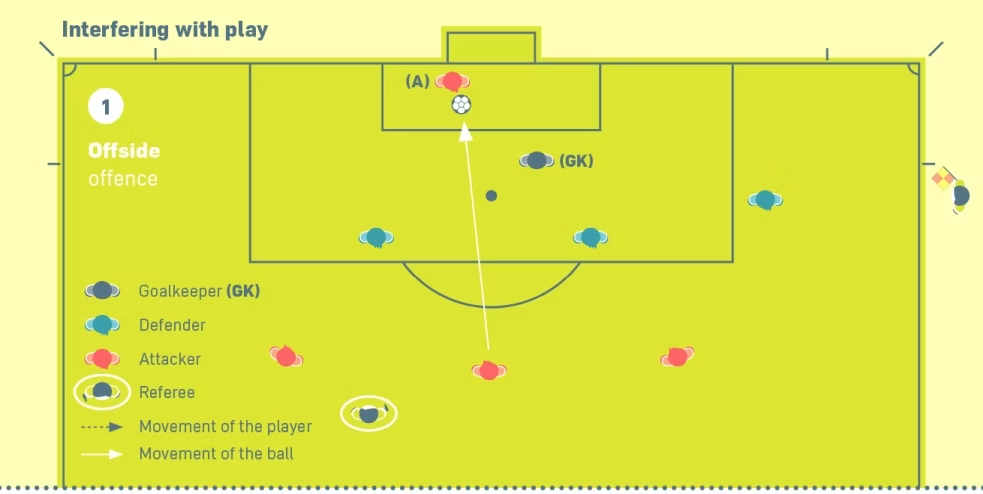
1. Interfere with Play
This is the most common situation.
The player receives or plays the ball after it was passed by a teammate.
Example:
A forward runs behind the defense before the pass is made. The teammate passes the ball to them, and they collect it. Offside.
2. Interfere with an Opponent
A player doesn’t have to touch the ball to be offside.
They may be penalized if they:
- Block a defender’s movement.
- Prevent the goalkeeper from seeing the ball.
- Challenge an opponent for the ball.
- Distract or interfere with an opponent’s ability to play.
Example:
A player standing directly in front of the goalkeeper screens their vision while a teammate shoots from outside the penalty area. Even if the screened player never touches the ball, they may be called offside.
3. Gain an Advantage
Sometimes the ball rebounds instead of being deliberately played.
If a player in an offside position receives the ball after it rebounds from:
- the goalpost,
- the crossbar,
- the goalkeeper,
- or another save,
they have gained an advantage from being offside.
Remember: It’s Okay to Wonder, Not Okay to Argue
The offside rule is one of the most challenging calls for players, coaches, and spectators to judge. Decisions are made in a split second, often by volunteer or youth referees who must determine a player’s position at the exact moment the ball is played. It’s perfectly natural to react to a close call or quietly say, “Offside!” in the excitement of the game.
However, under Utah Youth Soccer Association’s Zero Tolerance Policy, comments directed at referees, arguing calls, or criticizing their decisions are not acceptable. The policy exists to create a positive environment for everyone involved and to protect referees from abuse so they can continue serving the game. Parents and spectators are encouraged to cheer for the players and leave officiating to the referee crew. If a coach believes there was a concern with the officiating, UYSA provides a formal process for submitting feedback after the match rather than addressing the referee during play.
By respecting officials, even when we disagree with a decision, we help create a better experience for our players and ensure youth soccer remains a fun, safe, and welcoming environment for all. Learn more by reading the UYSA Zero Tolerance Policy.